
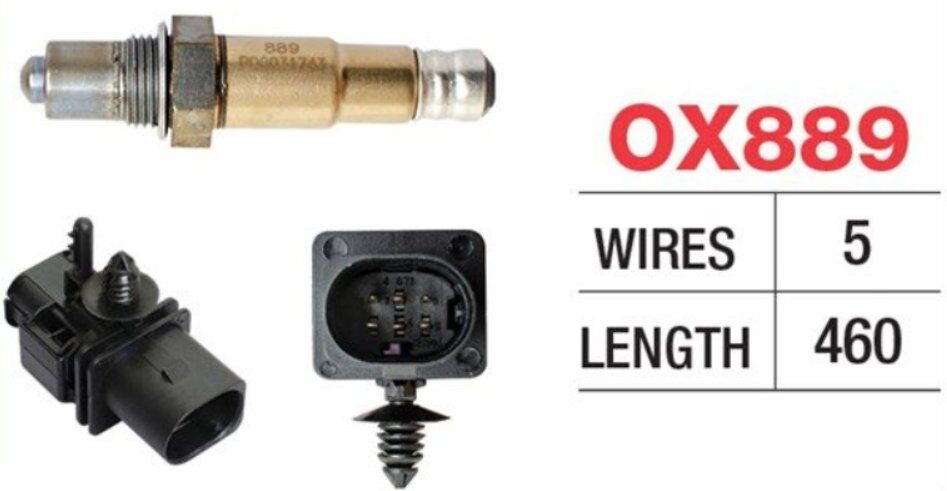
Description
The OX889 Oxygen Sensor is listed for the Hyundai Elantra AD D841F, covering the 2016–2020 model years with the advertised four-door body style and 2.0-litre inline four-cylinder, 16-valve engine. Designed as a replacement exhaust sensor, OX889 is intended to support accurate exhaust monitoring and engine management when its specifications match the vehicle’s original equipment requirements.
An oxygen sensor is an important component of a modern petrol engine’s electronic management and emissions-control systems. It measures the oxygen content in exhaust gases and sends information to the engine control unit (ECU). The ECU uses this information, together with data from other engine sensors, to help regulate fuel delivery and maintain an appropriate air-fuel mixture.
For a vehicle such as the Hyundai Elantra, which is commonly used for commuting, family transport and longer journeys, correct engine management helps support smooth operation and emissions control. When a faulty oxygen sensor is identified and replaced with the correct specification, the engine management system can receive the information it needs to operate as designed.
Before purchasing OX889, confirm the vehicle identification number (VIN), engine code, original equipment part number and required sensor position. The product title identifies the advertised application, but it does not independently guarantee compatibility with every Elantra variant sold between 2016 and 2020.
Product Specifications
- Product code: OX889
- Product type: Oxygen sensor
- Vehicle make: Hyundai
- Vehicle model: Elantra
- Model generation: AD
- Listed model code: D841F
- Listed model years: 2016–2020
- Listed body style: Four-door sedan
- Advertised engine capacity: 2.0 litres
- Engine configuration: Inline four-cylinder (I4)
- Advertised valve configuration: 16 valves
These details reflect the supplied listing. Engine specifications, emissions equipment and sensor requirements may vary by market, production date and engine code. Check the original equipment part number before ordering to ensure the replacement is appropriate for the exact vehicle.
Key Features and Benefits
1. Accurate Exhaust Oxygen Monitoring
The oxygen sensor measures the oxygen remaining in exhaust gases after combustion. Its signal helps the ECU evaluate the air-fuel mixture and make adjustments under suitable operating conditions.
When OX889 is confirmed to match the original sensor specification, it can serve as a replacement for a failed or deteriorated component and help restore the intended exhaust-monitoring function.
2. Support for Engine Management
The ECU relies on information from multiple sensors to manage fuel delivery and engine operation. Oxygen-sensor feedback helps the system respond to changes in engine load and operating conditions, including idling, acceleration and steady-speed cruising.
Replacing a confirmed faulty sensor with the correct specification may help restore normal engine-management behaviour. However, an oxygen sensor cannot correct unrelated problems such as faulty spark plugs, ignition coil issues, fuel-delivery faults or intake leaks.
3. Fuel Efficiency Support
Incorrect oxygen-sensor readings can affect fuel-mixture control and may contribute to increased fuel consumption.
Installing a correctly matched replacement may help restore normal fuel-control operation when the original sensor is responsible for the problem. Actual fuel economy depends on driving style, traffic, vehicle load, maintenance and the condition of other engine systems. Sensor replacement alone cannot guarantee a particular improvement.
4. Emissions-Control Assistance
Oxygen sensors provide important information for emissions control. Upstream sensors generally help regulate the air-fuel mixture, while downstream sensors commonly help monitor catalytic converter performance.
A suitable replacement sensor supports the intended operation of these systems. It may resolve an emissions-related fault when the sensor itself is defective, but it will not repair a damaged catalytic converter, exhaust leak or another underlying engine problem.
5. Correct Application Matching
Oxygen sensors can differ in connector design, wiring length, mounting thread, heater circuit and electrical response characteristics. Even sensors designed for the same vehicle generation may not be interchangeable if they serve different functions.
Before ordering OX889, compare the original equipment part number and confirm whether the required sensor is installed upstream or downstream of the catalytic converter.
Common Symptoms of a Faulty Oxygen Sensor
A deteriorating or faulty oxygen sensor may contribute to the following symptoms:
- Check engine warning light: The ECU may detect an abnormal signal, heater circuit problem or emissions-related fault.
- Increased fuel consumption: Incorrect sensor information can affect fuel-mixture adjustments.
- Rough or inconsistent idling: Faulty feedback may contribute to unstable engine operation.
- Hesitation during acceleration: Incorrect engine-management information may affect drivability.
- Emissions test failure: A sensor fault or related emissions problem may cause emissions to exceed permitted limits.
- Diagnostic trouble codes: A compatible scanner may identify sensor circuit, heater, signal-response or catalytic converter monitoring faults.
These symptoms do not automatically confirm oxygen-sensor failure. Intake leaks, exhaust leaks, wiring damage, ignition faults, fuel-system problems and catalytic converter deterioration can produce similar symptoms. Accurate diagnosis is recommended before replacing a component.
Understanding Upstream and Downstream Sensors
The Hyundai Elantra may use more than one exhaust sensor, depending on its engine and emissions configuration.
An upstream oxygen sensor is generally positioned before the catalytic converter. It provides feedback that helps the ECU regulate the air-fuel mixture.
A downstream oxygen sensor is generally installed after the catalytic converter. It commonly helps the ECU monitor catalytic converter efficiency.
These sensors can have different electrical characteristics and functions. They should not be assumed interchangeable simply because they look similar or use connectors with a similar shape.
Before purchasing OX889, confirm the required sensor position, original part number and compatibility with the exact Elantra engine and emissions specification.
Installation Guidelines
Oxygen sensor replacement requires care because the exhaust system becomes extremely hot during operation. Allow the vehicle to cool completely before beginning work. If you are unfamiliar with automotive electrical or exhaust repairs, use a qualified technician.
- Diagnose the fault: Use a compatible diagnostic scanner to read trouble codes and review available sensor data.
- Confirm compatibility: Match the VIN, engine code and original equipment part number to the replacement.
- Inspect the wiring: Look for damaged insulation, corrosion, loose connectors or heat damage.
- Remove the original sensor carefully: Use a suitable oxygen-sensor socket to reduce the risk of damaging the mounting threads.
- Install according to specifications: Follow Hyundai’s recommended tightening torque and the sensor manufacturer’s instructions.
- Secure the wiring: Ensure the connector is properly seated and the harness is routed away from hot or moving components.
- Verify operation: Record existing diagnostic codes before clearing them, then confirm that the relevant fault does not return after installation.
Do not force the sensor into place or modify the wiring if the connector or mounting arrangement differs from the original component. Recheck the part number and application before proceeding.
Maintenance and Troubleshooting
Oxygen sensors operate in a high-temperature environment and may deteriorate over time because of age, repeated heat cycles or contamination. Excessive oil consumption, coolant entering the combustion chamber and other engine faults can also affect sensor performance.
Follow the Hyundai maintenance schedule and investigate warning lights promptly. If a diagnostic code returns after replacement, check the sensor circuit, connector, exhaust system and other possible causes rather than automatically assuming that the new sensor is defective.
Important Fitment Notice
Before ordering OX889 for a Hyundai Elantra AD D841F listed for 2016–2020 with a 2.0-litre I4 16-valve engine, verify the VIN, engine code, original equipment part number, emissions specification and required sensor position. This is particularly important where different market versions use different exhaust components.
Conclusion
The OX889 Oxygen Sensor is listed for selected Hyundai Elantra AD applications from 2016 to 2020 with the advertised 2.0-litre inline four-cylinder engine. A correctly matched sensor supports exhaust monitoring, fuel-mixture control and emissions-system operation.
For reliable results, confirm exact vehicle compatibility before purchase, diagnose the underlying fault carefully and follow the manufacturer’s installation procedures. Correct sensor selection helps reduce fitment problems and supports dependable operation of the Hyundai Elantra’s engine management system.


Reviews
There are no reviews yet.